Strain-Wave vs. Planetary: Gearbox Tradeoffs for Legged Robots
When you're specifying a gearbox for a legged robot joint, the reduction ratio gets all the attention. Torque output, weight, and package volume follow closely. What gets underweighted in those early specs — consistently, in our experience — is how the gearbox behaves under shock loads, whether it can be back-driven, and what compliance characteristics it contributes to the overall joint dynamics. Those factors don't show up prominently in datasheets. They show up in prototype failures three months into integration.
This article compares strain-wave gearboxes with planetary designs across the criteria that actually matter for legged robotics. Not just ratio and torque density — the full picture.
Operating Principles: What Makes Each Architecture Different
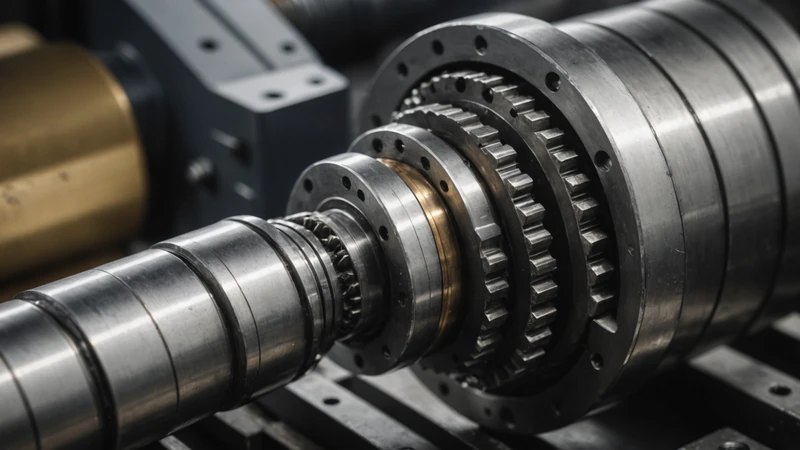
A planetary gearbox uses a central sun gear, typically three to five planet gears orbiting the sun, and a fixed ring gear. Torque enters at the sun shaft and exits through the planet carrier. The load is distributed across multiple planet gears simultaneously, which is why planetary gearboxes achieve high torque density in a relatively small package. Single-stage ratios typically run from 3:1 to 10:1; two-stage configurations reach 100:1 and beyond.
A strain-wave gearbox — commonly called a Harmonic Drive, though that's a brand name — uses a completely different mechanism. An elliptical wave generator rotates inside a thin-walled flexible steel cup (the flexspline). The wave generator's elliptical shape deflects the flexspline radially, engaging approximately 30% of the gear teeth with the rigid outer circular spline at any given moment. The difference in tooth count between the flexspline (fewer teeth) and the circular spline (more teeth) produces the reduction ratio. A 100:1 ratio is typical for a single stage; this is achieved in an extremely compact axial profile.
That compactness is the first major advantage. A strain-wave stage with a 100:1 reduction fits in an axial stack height of roughly 30–50mm for a 40mm bore diameter. A comparable two-stage planetary gearbox achieving 100:1 needs substantially more axial length — often 60–90mm for similar bore — because each planetary stage occupies its own gear plane.
Backdrivability: The Most Important Difference
In a planetary gearbox with typical manufacturing tolerances and lubrication, the mesh friction at 100:1 reduction is high enough that the output cannot back-drive the input under any reasonable external force. The joint is effectively self-locking. This is desirable in a fixed-arm industrial robot — the arm holds position under gravity without active braking. For a legged robot, it's a serious problem.
The strain-wave architecture produces meaningfully lower friction at the tooth mesh for a given reduction ratio. The rolling contact mechanics of the flexspline produce less Coulomb friction per transmitted Newton-meter than the sliding contact in planetary gear teeth. In a well-manufactured strain-wave stage at 80:1, the backdrive torque threshold can be 3–6 Nm for a 40mm unit — in the regime where active impedance control can be effective. A planetary stage at 80:1 typically requires 15–30 Nm to backdrive, depending on preload and lubrication state.
This is not a small difference. It's the difference between a joint that can participate in compliant locomotion with closed-loop force control and one that cannot, regardless of the sophistication of the control algorithm running above it.
Shock Load Tolerance: Where Planetary Has the Edge
Strain-wave gearboxes have one mechanical vulnerability that planetary gearboxes do not: the flexspline is a thin-walled elastic steel component operating under cyclic deflection. Impact loads — which a legged robot foot generates on every ground contact — produce stress concentrations in the flexspline tooth root. Over many impact cycles at loads above the rated peak torque, this can initiate fatigue cracks.
Planetary gearboxes handle shock loads more gracefully. The load distributes across multiple planet teeth simultaneously, and the steel gears are solid — no thin-walled flexure element involved. A planetary stage rated at 100 Nm peak may accept 5x shock loads for a few milliseconds without damage. A strain-wave stage at the same peak rating typically allows 2–3x shock multipliers before risking flexspline damage.
For hip and knee joints on a walking robot, where ground contact forces during dynamic locomotion can briefly exceed 3–5x the quasi-static joint torque, this shock tolerance difference matters. The mitigation on the strain-wave side is active control: an embedded torque sensor at the output, running a 1kHz impedance control loop, can detect impending overload and command joint compliance before the shock propagates to the flexspline. But that requires the sensor and the fast control loop to be there — it's not a purely mechanical fix.
Torsional Stiffness and Its Consequences
Strain-wave gearboxes have lower torsional stiffness than planetary gearboxes of comparable size, because the flexspline contributes compliance to the transmission path. At 40mm bore, a typical strain-wave unit might show 2,000–4,000 Nm/rad of torsional stiffness; a comparable planetary stage at 80:1 might reach 8,000–12,000 Nm/rad.
That compliance has two effects — one negative, one positive. Negative: the compliance adds a resonant mode to the joint that must be addressed by the control loop. If the impedance controller doesn't model the transmission compliance explicitly, the joint will ring at frequencies in the 50–150 Hz range under stepped torque commands, limiting closed-loop bandwidth. Positive: for bipedal locomotion, a small amount of transmission compliance acts as a mechanical low-pass filter on impact disturbances. Ground contact spikes that would transmit fully through a rigid planetary stage are partially absorbed by the flexspline's elastic response.
In practice, most teams we've talked to who have worked with both architectures prefer the strain-wave compliance for locomotion tasks. The extra resonant mode is manageable with a properly tuned inner-loop controller. The shock absorption benefit reduces wear and frame fatigue noticeably.
Summary: When to Use Each Architecture
| Property | Strain-Wave (Harmonic) | Planetary |
|---|---|---|
| Single-stage reduction | 50:1 – 160:1 | 3:1 – 10:1 per stage |
| Axial compactness | Excellent | Moderate (multi-stage) |
| Backdrivability at 80:1+ | Good (3–8 Nm threshold) | Poor (15–30 Nm threshold) |
| Shock load tolerance | Moderate (2–3x peak) | Good (4–5x peak) |
| Torsional stiffness | Moderate | High |
| Transmission compliance | Yes (beneficial for impact) | Negligible |
For most humanoid joint applications — hip, knee, ankle, shoulder, elbow — the strain-wave architecture is the right choice, provided the control system includes fast torque sensing and a well-tuned inner loop. The backdrivability and compact packaging advantages outweigh the shock load limitation for typical bipedal loading conditions. Planetary stages make more sense for high-shock applications (exoskeleton impact joints, quadruped toe joints in rough terrain) where self-protection from uncontrolled overloads is a priority and some backdrivability can be traded away.
There's no universally correct gearbox architecture for legged robots. There are correct architectures for specific joints at specific loading conditions. Getting that right requires knowing the shock load spectrum of each joint — which means running impact simulations before you finalize the mechanical design, not after the first prototype walks into a wall.
The choice of gearbox feeds directly into the control architecture: a strain-wave joint with known compliance parameters enables a much more accurate joint model in the impedance controller. We'll cover that connection in more depth in the impedance control article.