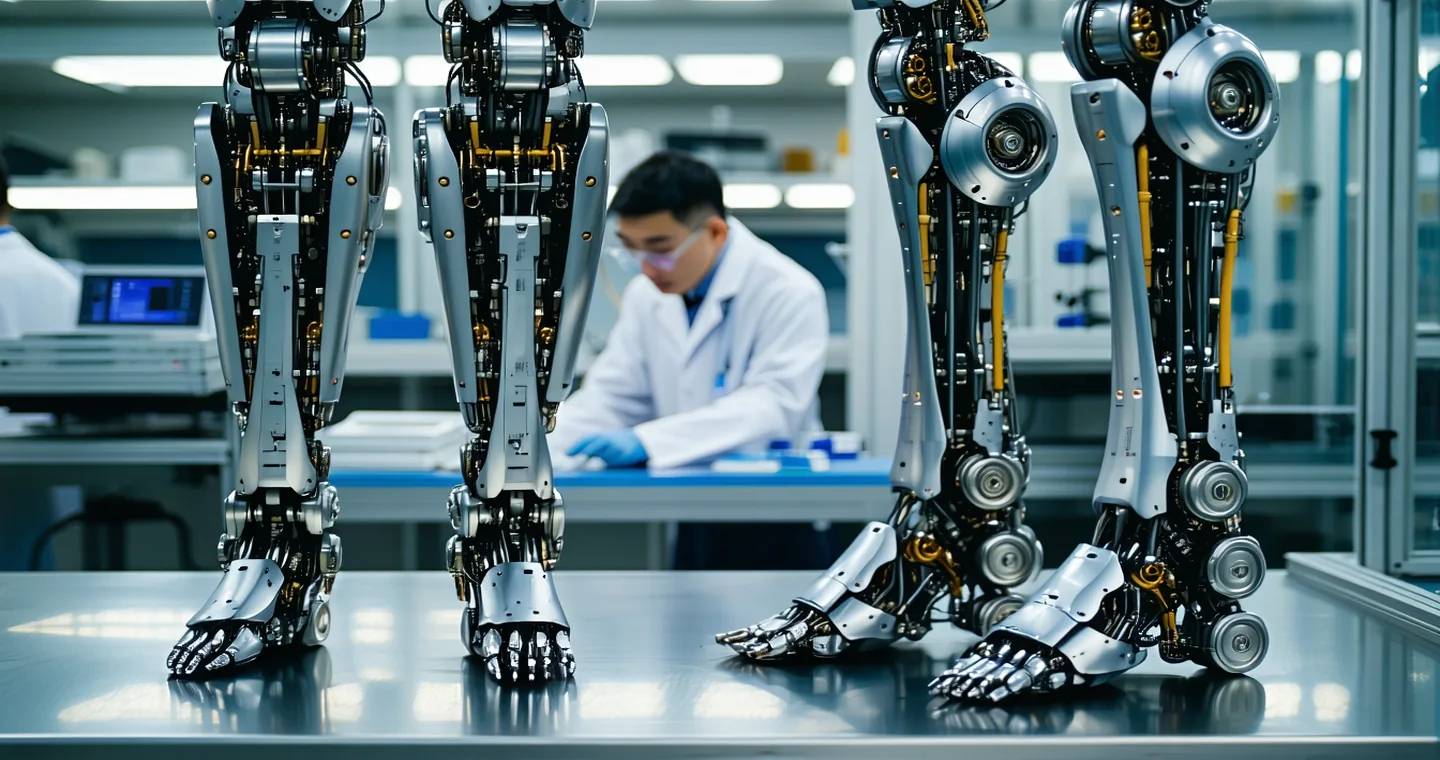
Application / Humanoid Robotics
A full-size humanoid needs 20–40 actuators, knee to shoulder. Every joint has different torque and bandwidth requirements. Tendonkindle supplies all three TK models with published torque-density specs, backdrivability curves, and ROS 2 firmware included.
Joint Mapping
Torque requirements vary 5:1 between a finger joint and a hip actuator. We designed three models so every joint in your design can be matched to the right spec without over-buying.
Wrist / Elbow / Ankle
120mm OD. Lowest mass at 0.43 kg. Ideal for distal joints with high-cycle but lower torque requirements. Backdrivability spec: 1.8 Nm reflected backdrive torque.
Shoulder / Knee
240mm OD. 42 Nm/kg peak torque density. The most popular model for full-size humanoid shoulder and knee joints. Peak torque: 105 Nm.
Hip / Lumbar / Load-bearing
IP67 sealed, EtherCAT-native, industrial grade. Peak 220 Nm. For load-bearing hip flexion and lumbar rotation joints that must handle payload-plus-bodyweight torques during locomotion on uneven terrain.
Supply chain approach
All three TK models run identical firmware. Same ROS 2 package, same EtherCAT profile, same impedance control API. One firmware update propagates to every joint in the robot. One engineering sample program, one NDA.
What we are not: Tendonkindle is not a drop-in replacement for a general industrial servo arm. We do not make single-axis rotary stages, SCARA arms, or delta robots. We design specifically for applications requiring high torque density in a compact package — humanoid joints, exoskeleton frames, and dexterous manipulation — where backdrivability and sub-millisecond torque bandwidth are required by the control architecture, not optional.
We'll send you a mapping table for your DOF count, torque requirements, and estimated power budget — no NDA required for initial scoping.
Request Engineering Sample